Renting a supercar for a driving trip is straightforward once you know the questions to ask. First-timers usually don't — they find the car on Instagram, book, and discover at the counter that the CHF 3,500 they thought they were paying is actually closer to CHF 7,000 once deposits, mileage charges and insurance excess are accounted for. What follows is the practical guide: how the market actually works, where to pick up, what to ask, and what to avoid.
Which city to collect from
The main pickup cities for alpine driving, ranked by supercar availability:
Zurich is the default. It has the deepest fleet of any European city — Porsche, Ferrari, Lamborghini, AMG, McLaren — and the best position for a Swiss-based trip (Furka, Grimsel, Susten, Klausen all within two hours). Zurich Airport (ZRH) has dedicated high-end rental desks; most premium operators also offer hotel delivery. Expect CHF 1,200–2,500 per day for a base-model Porsche 911, CHF 3,500–5,000+ for a Ferrari or Lamborghini. Weekly deals are typically 20% cheaper than 7× daily.
Geneva is smaller but positions you for the Route des Grandes Alpes and the French passes. Fleet depth is roughly two-thirds of Zurich. Handover quality is high — most Geneva operators are relationship-driven and will meet you at the airport.
Munich is the German anchor. Strong BMW M and AMG fleet, good Porsche availability, slightly weaker on Italian exotics. Best for Deutsche Alpenstrasse, Austrian Alps and Dolomites-via-Innsbruck trips. Munich Airport has good infrastructure and derestricted autobahn stretches immediately south.
Milan is strong for Dolomites, Stelvio and Italian coastal runs. Prices are generally lower than Swiss cities, but operator quality is more variable — verify insurance terms carefully. Malpensa (MXP) is a 90-minute transit to Lake Como and the Bernina approach.
Innsbruck is smaller still, but the right pickup if your trip centres on the Timmelsjoch, Grossglockner and Austrian east. Fleet is tighter and prices higher per day, but the positioning saves hours of transit.
If you are flying in for a 3–7 day trip, pick the city that minimises transit to your first and last drive day. An extra CHF 500 in rental cost is trivial compared to two days lost to transit.
What the day rate actually buys you
This is where first-time renters get caught. A "CHF 1,500/day" listing on a supercar operator site typically covers:
- The car
- Basic insurance (with an excess of EUR 10,000–35,000 — this is the part to watch)
- 200–250 km of mileage per day
- Pickup and return at the operator's base
It does not typically cover:
- Mileage over the daily cap (EUR 1–5 per km over)
- Fuel (return with the same amount as at pickup)
- Cross-border fees (many operators charge EUR 50–150 per additional country on your route; Italy and Austria are usually free for Swiss operators, others extra)
- A deductible reduction (buying down the excess from EUR 25,000 to EUR 2,500 typically costs EUR 100–200/day)
- Toll and vignette costs
Ask for the total figure, not the day rate. A seven-day Porsche rental advertised at CHF 8,400 (CHF 1,200/day × 7) is often closer to CHF 12,000–14,000 once mileage, deposit charges, insurance upgrades and optional extras are added.
Mileage caps matter more than the day rate
A 200 km/day cap sounds fine until you look at a real route. The Swiss Big Three (Furka/Grimsel/Susten) is 135 km of passes plus 100 km of transit — 235 km day one, so you're over before dinner. Route des Grandes Alpes averages 120 km/day of actual driving plus transit — doable. A Dolomites-with-Stelvio day is easily 250–300 km.
If your route averages more than 200 km/day, negotiate the unlimited-mileage upgrade before booking. Most premium operators offer it at EUR 50–150/day. It almost always pays.
Deposit holds
Expect a deposit hold on your credit card of EUR 5,000–15,000 for the duration of the rental. Not a charge — a hold. On a Ferrari or McLaren, the hold can be EUR 30,000+.
Two things to know:
- The hold is on a credit card, not debit. Operators routinely reject debit cards regardless of balance.
- The hold is in addition to the rental fee. If you have a CHF 10,000 limit and a CHF 8,000 rental plus CHF 15,000 deposit, you are over.
Raise your limit or use a dedicated card for the trip.
Insurance — the real question
Every supercar rental comes with insurance. The question is how much excess you are personally on the hook for if something goes wrong.
Typical excess structure:
- Standard: EUR 10,000–35,000 (what you pay out of pocket on damage)
- Reduced: EUR 2,500–10,000 (with an insurance upgrade, EUR 100–200/day)
- Zero: occasionally offered, expensive, rarely needed
A stone chip, a kerbed wheel, a scrape in a car park all come out of this excess. If you have any experience of driving rental cars through the Alps, you know that minor damage happens. Upgrade the insurance. The EUR 700–1,500 you spend on reducing the excess for a week is substantially less than the EUR 2,500 minimum you'll pay otherwise on almost any damage claim.
Your personal credit card or travel insurance may cover rental car damage — do not assume it extends to supercars. Most cards have an MSRP cap (often USD 75,000) that excludes anything interesting. Read the policy.
What to verify before signing
Go through this checklist at pickup:
- Fuel level — photograph the gauge. Return at the same level or pay the premium refuel fee.
- Existing damage — walk around with the operator, photograph every scratch and stone chip. Get it noted on the contract.
- Tyre tread — for a driving trip, you want good tread. Supercar tyres wear fast on alpine passes; a car handed over with 30% tread will be bald by day three.
- Mileage — record the starting odometer on the contract.
- Included equipment — many operators charge for GPS, child seats, additional drivers, cross-border permits. Ask for a per-item list.
- Drop-off time — late return fees are steep (often a full day's rate for 30 minutes over).
Do the walkaround in daylight, and do not skip this because the handover agent is friendly. Everyone is friendly at handover; it's return time that the small stuff matters.
Driving considerations specific to supercars
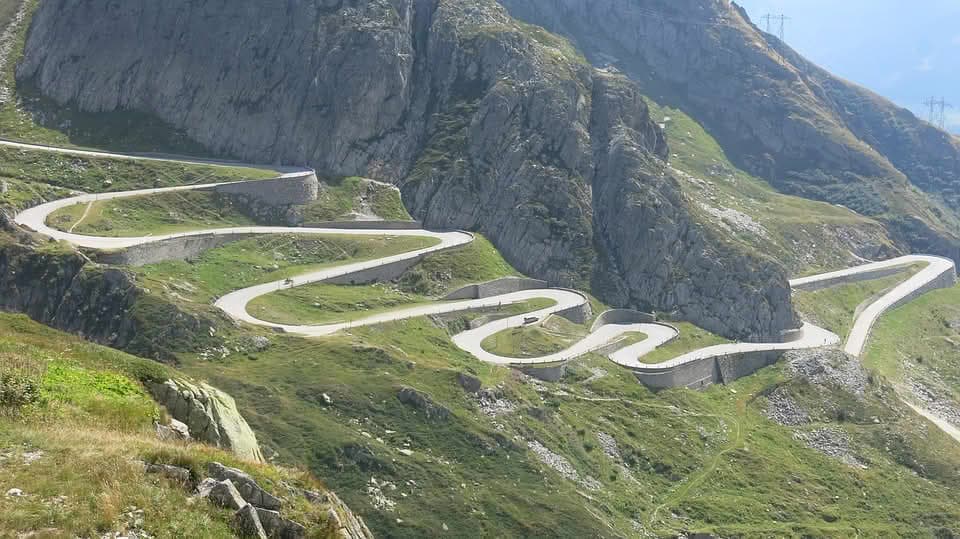
- Clearance: many of the best alpine roads have drainage bars, speed bumps and cobblestones that a 60mm Ferrari nose does not like. The Gotthard Tremola, the Sella Ronda back routes and the high Stelvio hairpins all have surfaces that can scrape a lowered car. Ask your operator — they know which roads their cars routinely come back damaged from.
- Width: an 1.95m Lamborghini will struggle in single-lane sections where a 1.75m Porsche 911 is fine. The Grossglockner has some of the tightest passing stretches in the Alps; so does the Susten north descent.
- Fuel: high-octane (98 RON / 95+ premium) is required for most supercars. Every major Swiss, Austrian, German and Italian petrol station has it. Remote alpine stations sometimes do not. Plan accordingly.
- Visibility: most supercars have terrible rearward visibility. Parallel parking on Swiss town main streets is an exercise. Factor this in when picking hotels — somewhere with covered or valet parking saves a lot of stress.
Where to find operators
- Rental hub — all cities — our curated list of operators by city
- Zurich rentals — the densest market
- Geneva rentals — for Route des Grandes Alpes trips
- Munich rentals — Deutsche Alpenstrasse and Austrian Alps
- Milan rentals — Dolomites and Stelvio
- Innsbruck rentals — Tyrol and eastern Alps
Each city page lists operators we have worked with or have verified, with typical day rates, fleet details and contact notes.
The short version
Pick the city that minimises transit. Get the total price including mileage, insurance upgrade and cross-border. Use a credit card with headroom for a five-figure deposit. Photograph everything at handover. Upgrade the insurance excess reduction. Don't rent a car with 30mm of ground clearance for a trip that includes the Gotthard Tremola. Do this right and a supercar rental is the single best way to experience the Alps — do it wrong, and the holiday is stressful long before you have driven a pass.